
The Bauhaus is not merely a school or an aesthetic style: it represents a pivotal moment in the history of design and architecture—a watershed that opened the doors to modernity. Born in the early decades of the 20th century, the Bauhaus movement defined new criteria of functionality, simplicity and experimentation, influencing furniture, graphics, art and interior design. In this article we delve into the meaning of Bauhaus, learn how to recognise its typical features and meet the architects and designers who shaped its evolution. Whether you seek a minimalist, “rational” approach to space or are simply a curious lover of design history, you will find everything you need to understand the legacy of this movement, still highly relevant in contemporary projects.
INDEX
- Why Bauhaus Marked a Turning Point in Design
- The Meaning of Bauhaus: Roots and Innovative Spirit
- The Foundational Principles of Bauhaus Style
- Bauhaus Architects and Designers: The Most Influential Figures
- Materials and Forms: The Language of Bauhaus Design
- Materials and Techniques: A Mini Glossary for Recognising Bauhaus
- Influence on Furniture: Iconic Chairs, Tables and Accessories
- Ten Iconic Bauhaus Pieces: Furniture, Lighting and Everyday Objects
- From the Weimar Workshop to Modern Architecture
- Bauhaus Architecture and Sites to Visit: Weimar, Dessau and Beyond
- How to Integrate Bauhaus Style into Your Interiors
- Beyond Furniture: Bauhaus Typography, Posters and Visual Grids
- Bauhaus Colour Palette, Shapes and Proportions: A Quick Recognition Guide
- Tips and Ideas for a Bauhaus-Inspired Living Room
- How Bauhaus Remains Alive in the Contemporary World
- Real-World Examples: Bauhaus Objects and Projects to Know
- Conclusions: The Legacy and Relevance of Bauhaus
1. Why Bauhaus Marked a Turning Point in Design
To grasp the scope of Bauhaus style, consider that much of modern aesthetics—from minimalist furniture to rational glass-and-concrete buildings—draws at least partly on that movement. Before Bauhaus, design and architecture were still closely tied to ornamentation, classical motifs or, in some cases, an excessive Art-Nouveau taste. The birth of the Bauhaus school in Germany was a clean break: it aimed to fuse art and craft in a holistic vision where every object, from a chair to a skyscraper, had to meet principles of functionality, formal simplicity and maximum efficiency.
This new approach was revolutionary because it did not stop at teaching “how to decorate” but focused on the creative and production process, urging designers, architects and artists to experiment with industrial materials such as tubular steel, to simplify forms by reducing them to essential lines and to conceive spaces in a pragmatic, open way. Thus Bauhaus became the cradle of modernity, profoundly influencing 20th-century taste and paving the way for furniture and construction styles we still see as contemporary and ground-breaking.
2. The Meaning of Bauhaus: Roots and Innovative Spirit
But what does Bauhaus mean? Literally “building house,” it is the word that named the school founded in 1919 in Weimar by architect Walter Gropius. The Bauhaus was born as an experimental workshop, uniting art, craft, design and industrial production. Gropius dreamed of a place where painting, sculpture, applied arts, furniture design and architecture could be taught in an integrated way, overcoming the division between artist and artisan.
The Spirit of the Time
Post-World-War-I Germany was teeming with social and cultural ideas: people yearned for a more rational, functional future, far from past excesses. The Bauhaus captured this drive, aiming to design useful objects for modern life and a growing industrial society. Its motto? Bring art into everyday life with beautiful, democratic and accessible objects.
The Phases of Bauhaus
- Weimar (1919-1925): directed by Gropius. An artisanal spirit and experiments with abstract forms and basic ideas.
- Dessau (1925-1932): new campus in a futuristic building by Gropius. The focus shifts to industrial design, with teachers such as Moholy-Nagy, Kandinsky and Klee.
- Berlin (1932-1933): final phase under Mies van der Rohe, marked by political pressure from the Nazi regime that led to the school’s closure.
Despite its short life (it closed in 1933), the Bauhaus influenced architecture and design worldwide through publications and the emigration of many masters forced to leave Germany. The Bauhaus style became a reference for later modern movements (International Style, Minimalism and beyond).
3. The Foundational Principles of Bauhaus Style
Bauhaus design can be summed up in core principles that revolutionised the concept of aesthetics and functionality:
- Form follows function: every object must arise from a practical purpose, avoiding superfluous decoration.
- Formal simplification: clean lines, basic geometries (circle, square, triangle), use of primary colours (red, blue, yellow) and neutrals (white, black, grey).
- Industrial production: products had to be manufacturable in series at low cost without losing quality. Steel tubing became emblematic.
- Unity of art and technology: designers and artisans worked together, blending artistic knowledge with industrial processes to overcome the split between art and everyday objects.
- Functionality and usability: chairs, tables and lamps had to be comfortable, ergonomic and meet real user needs.
These tenets produced minimal objects with light metal structures, essential padded seats, flat surfaces and decoration reduced to lines or geometric colours. Over the years, Bauhaus teachers and students interpreted these principles in their own way, but the common root remained the search for a universal and “honest” formal language.
4. Bauhaus Architects and Designers: The Most Influential Figures
The Bauhaus gathered leading figures who shaped design and architecture history:
- Walter Gropius (1883-1969): founder and first director, architect known for rational layouts and glass-and-steel buildings. He created a revolutionary teaching approach by uniting arts and crafts.
- Marcel Breuer (1902-1981): pupil and later teacher, he designed the Wassily Chair (1925) in tubular steel, an icon of Bauhaus. He later built notable structures in Europe and the USA.
- Mies van der Rohe (1886-1969): director from 1930 to 1933, author of modernist masterpieces (Barcelona Pavilion, Seagram Building in New York). His Barcelona Chair remains legendary.
- Wassily Kandinsky (1866-1944): abstract painter who taught colour theory and form as a universal language.
- Paul Klee (1879-1940): experimental artist, lectured on colour and composition. His teachings inspired generations of designers to exploit simple forms and chromatic nuances.
Other names include László Moholy-Nagy (photography and experimental typography), Josef Albers (graphic design and painting), Gunta Stölzl (textiles) and Marianne Brandt (metal objects). These people laid the groundwork for design “for everyone,” with great attention to technology and production processes. Many modern furniture and lighting lines trace their roots back to them.
5. Materials and Forms: The Language of Bauhaus Design
One distinctive feature of Bauhaus is the synthesis of basic geometric forms with industrial materials, leading to instantly recognisable objects:
- Steel tubing: used for chairs, armchairs and tables, enabling light, robust, hygienic structures devoid of superfluous ornament. Marcel Breuer pioneered bent-tube seating such as the Wassily and Cesca.
- Wood combined with metal: some chairs pair metal frames with plywood or cane seats and backs (e.g., the Cesca). The goal was serial, affordable production.
- Geometric forms: rectangles, circles and straight lines define shelves, lamps and tables—no baroque curves or floral decoration, everything reduced to the essential.
- Primary and neutral colours: the Bauhaus palette favoured white, black, grey and primary hues. Colour contrast highlighted structures and volumes.
- Modularity: the idea of easy assembly and variable configuration met the needs of different spaces. Many Bauhaus pieces can be disassembled or combined in multiple layouts.
The result is an aesthetic that may appear “cold” compared with decorative styles but expresses rigour and coherence that have won millions of enthusiasts worldwide. A century later, these objects remain surprisingly current—think of Mies van der Rohe’s Barcelona Chair or Breuer’s Laccio Table.
6. Materials and Techniques: A Mini Glossary for Recognising Bauhaus
Many objects feel “Bauhaus” because of how they are made, not only because of how they look. This short glossary helps you read materials and manufacturing choices in a more informed way—especially when evaluating vintage pieces or authorised re-editions.
- Tubular steel: bent metal tubes that create continuous frames. It is central to the Bauhaus furniture materials story because it enabled lightness, strength and repeatable production.
- Chrome plating: a reflective finish that protects the metal and reinforces the “machine-age” character.
- Cantilever frame: a structure with no rear legs (as in many Breuer designs), relying on the elasticity of steel for support.
- Opaline glass: milky, diffusing glass used in lamps to soften glare while keeping forms pure.
- Moulded plywood: thin wood layers shaped under heat and pressure; while more associated with later modern design, it connects to the Bauhaus interest in engineered materials.
- Cane / woven seat: a craft technique often paired with industrial frames (e.g., Cesca), illustrating the Bauhaus goal of merging workshop knowledge with modern production.
- Laminate and lacquer: smooth, cleanable surfaces suited to functional interiors and serial manufacturing.
If you are building a coherent interior scheme, this material awareness pairs well with our guide on choosing the right materials for home furniture.
7. Influence on Furniture: Iconic Chairs, Tables and Accessories
Many Bauhaus architects created furniture masterpieces still produced today by historic brands (Knoll, Cassina, Thonet, Gavina, etc.). Examples include:
- Wassily Chair (Breuer, 1925): chrome-steel tubing with leather seat and back. Named later in honour of Kandinsky. It is considered one of the first chairs made with a tubular-steel structure.
- Cesca Chair (Breuer, 1928): another Breuer icon. Cane seat and back on a cantilevered steel frame—lightness and timeless comfort.
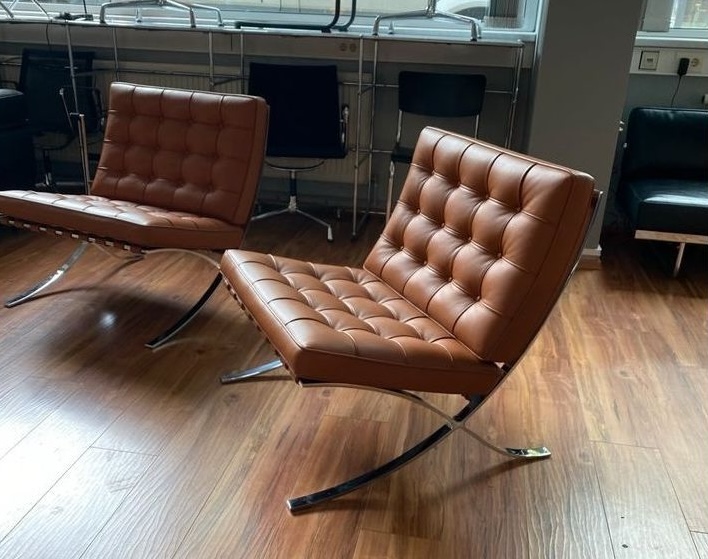
- Barcelona Chair (Mies van der Rohe, 1929): created for the German Pavilion at the Barcelona International Exposition. Polished-steel base and quilted leather cushions—an icon of modern elegance.
- Bauhaus Lamp: desk-lamp models by Wilhelm Wagenfeld in metal and glass, embodying the school’s formal purity.
- Laccio Table (Breuer, 1925): rectangular top in laminate (or glass) on a tubular frame. Often sold as nested pairs of different sizes, embracing practicality and simple lines.
Anyone wanting a Bauhaus touch at home can start with single iconic pieces—a cantilever chair, a minimal table or a chrome-metal lamp—to add character and history to contemporary décor.
8. Ten Iconic Bauhaus Pieces: Furniture, Lighting and Everyday Objects
If you are looking for bauhaus examples that go beyond the usual list of chairs, it helps to map the movement through objects that share a common grammar: simple geometries, honest materials and a clear relationship between form and use. Here are ten references often cited as bauhaus iconic design, each for a specific reason.
- Wassily Chair (Marcel Breuer, 1925): the archetype of tubular-steel seating. The structure echoes bicycle frames: lightweight, strong and built around the idea of serial production.
- Cesca Chair (Marcel Breuer, 1928): the cantilever frame removes the rear legs and gives a “floating” feel. Cane and steel combine craft and industry in a single gesture.
- Barcelona Chair (Ludwig Mies van der Rohe, 1929): designed for the German Pavilion at the Barcelona International Exposition. It is often associated with the Bauhaus sphere, even though it was not a school workshop product; it embodies the same modern ethos through refined proportions and industrial precision.
- Wagenfeld Table Lamp / “Bauhaus Lamp” (Wilhelm Wagenfeld, 1924): metal and opaline glass, reduced to a calm and logical construction. Today it is famously produced in licensed editions (often associated with Tecnolumen) and remains a benchmark for functional lighting.
- Kandem Lamp (Marianne Brandt & Hin Bredendieck, late 1920s): a compact reading lamp whose cone-and-sphere geometry turns light into a designed, controllable tool.
- Bauhaus Chess Set (Josef Hartwig, 1923): an object that makes the rules visible. Each piece’s form suggests its moves—an elegant example of “function expressed through shape.”
- Tea Infuser and Metal Workshop Objects (Marianne Brandt, 1920s): small domestic items where circles, cylinders and precise joinery become a language rather than decoration.
- Cradle (Peter Keler, 1922): a surprising Bauhaus object: primary colours and elementary forms applied to a children’s piece, showing how the school experimented beyond furniture for adults.
- F 51 Armchair (Walter Gropius, 1920): early Bauhaus furniture still tied to crafted timber, but already disciplined in its volumes and in the relationship between frame and cushions.
- Built-in Wardrobes and Modular Storage (Bauhaus interiors, 1920s): less “collectible” than chairs, but crucial to the Bauhaus interior design idea: storage becomes architecture, aligned with walls, optimised for daily routines.
To explore other classics that shaped 20th-century taste, you may also enjoy our selection of design icons that changed the way we live and, for lighting lovers, a dedicated read on iconic table lamps.
9. From the Weimar Workshop to Modern Architecture
Beyond chairs and accessories, Bauhaus style revolutionised architecture, redefining the building as a “machine for living.” Considering works by Gropius, Mies van der Rohe or Hannes Meyer, we find:
- Linear façades: smooth surfaces, ribbon windows, absence of decoration.
- Parallelepiped volumes: buildings designed as pure geometric forms, often on pilotis or with large glass expanses.
- Functional layouts: interiors planned to serve daily activities, removing unnecessary walls and favouring open space—pioneering at the time.
- Use of reinforced concrete and steel: for light, bright structures.
- The slogan “less is more”: coined by Mies van der Rohe, translates into essential buildings that highlight constructive rationality.
These principles gave rise to the International Style: houses, offices, schools and skyscrapers worldwide follow the trail blazed by Bauhaus.
10. Bauhaus Architecture and Sites to Visit: Weimar, Dessau and Beyond
Design objects tell one side of the story; buildings show the movement at full scale. If you are planning an itinerary of bauhaus sites to visit, Germany remains the essential starting point—especially bauhaus weimar and bauhaus dessau—because it is there that the school changed its methods and its relationship with industry.
Weimar: the origins
- Weimar: the birthplace (1919) of the Walter Gropius Bauhaus movement. In the early phase, workshops and teaching focused on craft, experimentation and the search for a new visual vocabulary.
- Bauhaus Museum Weimar: a useful stop to frame the beginnings through objects, sketches and teaching materials.
Dessau: the modern language takes shape
- Bauhaus Building in Dessau: Gropius’s campus is a manifesto of glass façades, functional volumes and clarity of circulation—one of the best “readable” buildings in modern architecture.
- Master Houses (Meisterhäuser), Dessau: the residential cluster for masters. Visiting them helps you understand proportions, built-in solutions and the practical side of Bauhaus interior design.
- Bauhaus Museum Dessau: complements the visit with prototypes and everyday pieces, reinforcing the link between school research and serial production.
Industrial modernism and the wider map
- Fagus Factory (Alfeld, 1911–): designed by Gropius and Adolf Meyer before the Bauhaus founding, it anticipates the “machine-age” look with glass corners and a radical industrial clarity; it is often cited when discussing the roots of the movement.
- Berlin (1932–1933): the last, pressured phase under Mies van der Rohe, ending with the closure in 1933 and the spread of ideas abroad.
If you want to place Bauhaus within the broader narrative of modern architecture, you can continue with our overview of the Modern Movement in architecture and design and our profile on Ludwig Mies van der Rohe.
11. How to Integrate Bauhaus Style into Your Interiors
If you want a Bauhaus touch at home, you can adopt a few strategies:
- Reduced palette: rely on white, black, grey and touches of red, blue, yellow. Solid colours, few gradients.
- Geometric lines: choose furniture with sharp forms (rectangles, circles, tubes) and minimise ornament. Square shelves, tubular chairs, tables with regular tops.
- Typical materials: integrate steel-and-leather chairs (Wassily, Cesca), chrome-metal lamps, aluminium shelving, laminated or painted-wood tables.
- Industrial finishes: a white-brick wall or polished-concrete floor can evoke the Bauhaus “workshop” atmosphere.
- Few accessories: Bauhaus spaces are not overloaded with décor. Perhaps one abstract painting, some Moholy-Nagy-inspired typographic posters, a geometric rug.
Consistency is key. A classic Chesterfield sofa may clash with a Bauhaus table unless you adopt a consciously eclectic approach. Formal and functional synthesis is essential to recreate the essence of Weimar and Dessau.
12. Beyond Furniture: Bauhaus Typography, Posters and Visual Grids
When people think of Bauhaus, they often picture chrome frames and leather. Yet the movement also reshaped visual communication: layout, type and posters became part of the same functional project. Recognising bauhaus typography helps you spot the style even in contemporary branding.
- Sans-serif typefaces and clarity: the preference for clean, legible lettering aligns with the rejection of ornament. Typography is treated as architecture on the page.
- Grids and asymmetry: posters frequently use strong alignments, modular spacing and off-centre compositions, creating rhythm without decorative excess.
- Photomontage and experimentation: László Moholy-Nagy’s research into photography and printing influenced bauhaus poster design, where images, type and geometry interact as a single system.
- Colour as structure: blocks of red, blue and yellow (plus black/white) are often used to guide the eye, not to “beautify” the page.
In interiors, this translates into a precise way of placing wall art: a poster is not a filler, but a compositional anchor. If you enjoy reasoning in terms of balance and focal points, you may find practical parallels in our guide on common living room decorating mistakes.
13. Bauhaus Colour Palette, Shapes and Proportions: A Quick Recognition Guide
One of the easiest ways to recognise Bauhaus is to look at the visual “alphabet.” The classic bauhaus color palette is not about making everything bright; it is about using colour like a diagram, with disciplined contrasts and a limited set of tones.
Colours: primaries with neutral anchors
- Primary colours (red, blue, yellow) used as accents and signals. Think of them as punctuation, not as a full paragraph. This approach is often summarised as primary colors Bauhaus.
- Neutrals: white, black and greys create the base, enhancing light and legibility of forms.
- Metal finishes: chrome and brushed steel act like an additional neutral, reflecting the environment and keeping the palette coherent.
Shapes and composition
- Basic geometries: circle, square, rectangle and triangle recur in furniture profiles, lampshades and graphic layouts.
- Clear proportions: elements are sized to their function—handles are graspable, shelves are modular, seating is engineered for comfort rather than sculptural effect.
- Negative space: empty surfaces are intentional; they make the few chosen objects feel more meaningful.
Practical tip: if you want to try a Bauhaus-inspired corner without turning the room into a set, start from a neutral base and introduce one strong accent (a primary-colour artwork, a geometric rug, or a single chromed lamp). For broader guidance on coordinating tones, see our article on how to choose living room colours.
14. Tips and Ideas for a Bauhaus-Inspired Living Room
Imagine setting up a Bauhaus-inspired lounge:
- Walls and floor: light shades (white or grey), floor in resin concrete or neutral-coloured plank parquet.
- Sofa and armchairs: a minimal sofa in anthracite grey fabric alongside two black-leather, chrome-frame Wassily armchairs.
- Coffee table: Breuer’s Laccio Table or a glass top on a metal-tube frame, paired with a geometric rug in red and blue tones.
- Wall unit or shelving: painted-metal structures with glass or white-laminate shelves, simple geometries. No superfluous ornament—just books and design objects.
- Lighting: ceiling lamps in chrome metal, perhaps inspired by Christian Dell. Abstract Kandinsky or Moholy-Nagy posters on the wall.
The outcome is an austere yet striking space, focusing attention on clean lines and a few high-value formal pieces—a connoisseur’s living room reflecting a rational, cultured way of living.
15. How Bauhaus Remains Alive in the Contemporary World
Although the Bauhaus school closed in 1933, its influence lived on, migrating with masters who found work in Europe and the United States and permeating later architectural and design movements. Post-1950 International-Style buildings reprise concepts of essential volumes, open plans and curtain-wall façades. In industrial design, the lessons of steel tubing and modularity inspired brands like Kartell, Cassina and Vitra to keep producing and re-editing Bauhaus-inspired furniture.
Bauhaus and New Technologies
Today, 3D printing, automation and smart-home systems may seem distant from Bauhaus, yet they share the same roots: uniting technology and art to improve daily life, creating products whose form coheres with function. Contemporary designers continue to reference the Bauhaus legacy, simplifying objects and using innovative materials (carbon fibre, recycled polymers) in line with the “less is more” philosophy and pursuit of maximum usability.
Rediscovery of Vintage
Many original 1920s-’30s chairs, tables and lamps are now coveted collectibles fetching high prices. Alongside them are official re-editions and tributes by various brands. Design collectors find Bauhaus pieces at vintage markets, online auctions or on platforms such as Deesup, where certified historical objects are sold through curated designer resale at competitive prices. In this way, Bauhaus allure renews itself and inhabits homes of enthusiasts worldwide.
16. Real-World Examples: Bauhaus Objects and Projects to Know
- Wassily Chair (Marcel Breuer, 1925): tubular-steel frame and leather seat—lightness and modernity manifesto.
- Wagenfeld Table Lamp (Wilhelm Wagenfeld, 1924): metal base, opaline-glass shade. Often referred to as the “Bauhaus lamp,” blending pure forms and functionality.
- Barcelona Chair (Mies van der Rohe, 1929): quintessential modernist elegance with metal frame and quilted leather cushions.
- Laccio Table (Breuer, 1925): rectangular top on a tubular line, available in various sizes, often nested.
Architectural projects:
- Bauhaus Building in Dessau (Walter Gropius, 1925): iconic structure with large curtain-wall façades and intersecting geometric volumes—now a museum and research centre.
- Master Houses (Dessau, 1926-1927): experimental homes for Bauhaus teachers—white geometric lines, rational plans.
- Fagus Factory (Alfeld, 1911–): a key precursor to Bauhaus industrial modernism, often used to explain how Gropius’s ideas matured.
- German Pavilion in Barcelona (Mies van der Rohe, 1929): though not a Bauhaus-school project, it shares modern principles and became a minimalist symbol.
Knowing these pieces and projects helps recognise Bauhaus inspiration and grasp how far the original idea of merging art and industry has travelled.
17. Conclusions: The Legacy and Relevance of Bauhaus
Bauhaus style is not just a past trend: it is a beacon for anyone seeking simplicity, function and beauty in design. The furniture, buildings and graphic works born in that environment left an indelible mark, influencing generations of creatives and redefining the very concept of “project.” If you love clean aesthetics, contemporary materials and a rational approach to décor, taking inspiration from Bauhaus principles is an excellent starting point.
From tubular-steel chairs to minimal tables, from metal lamps to abstract posters, Bauhaus or Bauhaus-inspired objects always give a room decisive character. Introduce one or two pieces—perhaps a Laccio table or a Cesca chair—to bring that historic, avant-garde aura into your living space. And if you are looking for original pieces or certified re-editions at more approachable prices, you can rely on luxury resale furniture marketplaces such as Deesup, where you may occasionally find real gems.
Ultimately, understanding the meaning of Bauhaus helps you navigate clean lines and essential colour choices, bringing home a slice of the experimental spirit that marked the 20th century. Among all furnishing styles, Bauhaus remains one of the clearest and most current, proving that good design—born of bold ideas and technical skill—is destined to outlast fashions and remain timeless.